


Is Every Scale That Reads 0.01 g a Jewelry Scale?
Not every precision balance that reads 0.01 g is a jewelry scale. Some load cell balances built for pharmacy, formulation and general precision weighing are also sold as jewelry scales. This article explains why 0.01 g readability alone is not enough, how a load cell weighing mechanism works and what to look for when choosing a scale for gold.

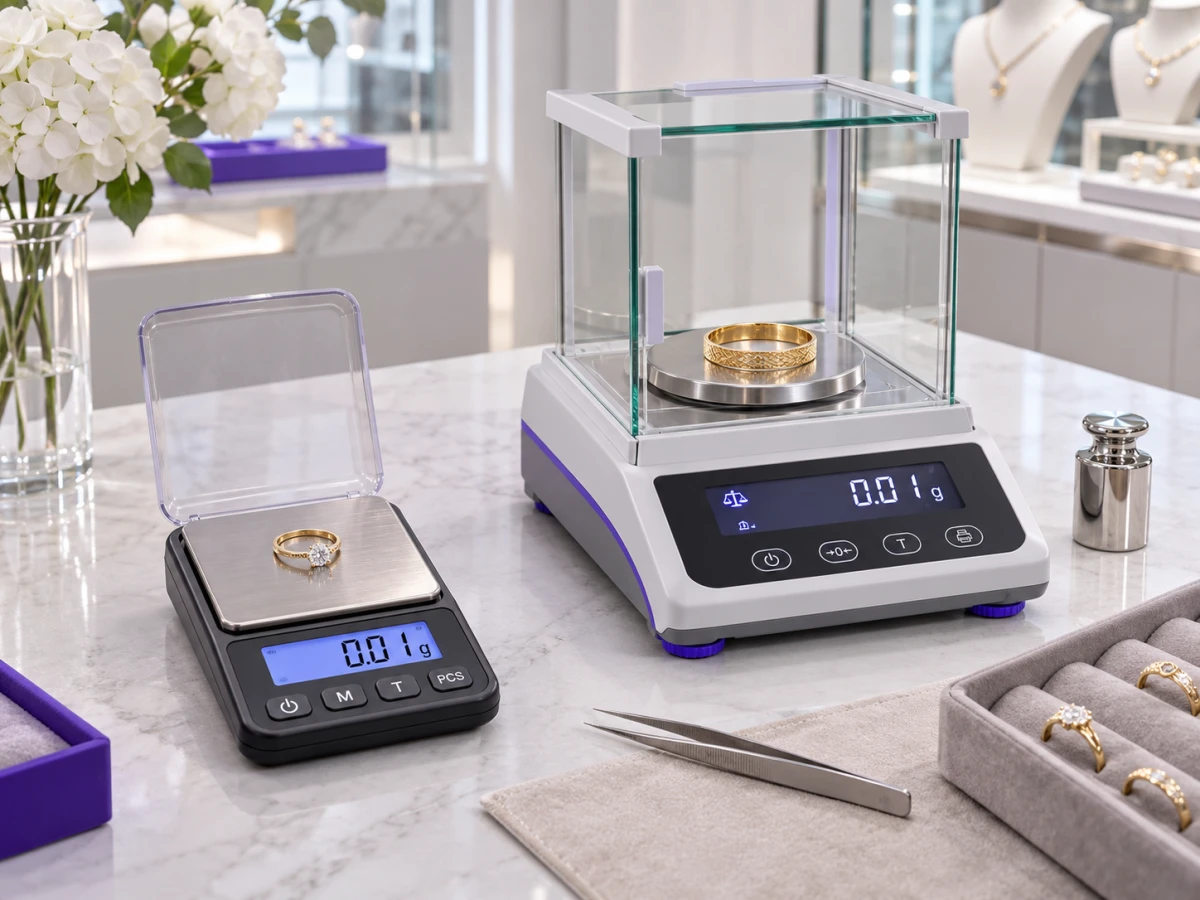
Is Every Scale That Reads 0.01 g a Jewelry Scale?
When buying a jewelry scale, the first things people usually look at are capacity and precision, which technically means readability. There are many scales on the market with capacities of 300 g, 600 g or more and a readability of 0.01 g.
But the fact that two scales both say 600 g x 0.01 g does not mean they were built for the same purpose or deliver the same measurement performance.
In recent years we have seen some economical scales, developed for pharmacy, formulation and general precision weighing, being marketed as jewelry scales simply because they offer 0.01 g readability.
When weighing gold, looking only at the number of digits on the display is not enough.
Considering the economic value of what is being weighed, what the device was made for, which weighing mechanism it uses, its measurement stability and the manufacturer's experience in weighing technology become far more important.
What Is a Load Cell Weighing Mechanism and How Does It Work?
The load cell is one of the most widely used load sensing technologies in the weighing industry. It can be found in many different devices, from industrial weighing systems and platform scales to retail scales and general-purpose precision balances.
The working principle of a load cell weighing mechanism is based on mechanical deformation.
When a weight is placed on the weighing pan, the force is transferred to the load cell. The metal body of the sensor flexes by an amount too small to see with the naked eye. The strain gauge elements on the sensor convert this change into an electrical signal. The scale's electronics then process this signal to produce the weight value we see on the display.
This is an extremely common and successful weighing technology. So it would be wrong to say that a device with a load cell weighing mechanism is poor or unreliable just because of the technology it uses.
What matters is the quality level at which the load cell system was designed and which weighing application it was developed for.
In a system based on mechanical deformation, sensor quality, electronic circuitry, mechanical design and temperature compensation directly affect measurement performance.
Load cell systems can also show a behavior called creep. When a load stays on the sensor for a certain time, small changes can occur in the output signal over time. How the sensor returns to its starting state after the load is removed also depends on the characteristics of the system used.
Similarly, temperature changes can affect both the metal structure of the sensor and the behavior of the electrical components.
Quality manufacturers try to keep these effects under control through sensor selection, mechanical design, electronic systems and various compensation methods.
For this reason, it is not right to place all scales with a load cell weighing mechanism in the same class.
A Pharmacy Scale Is Not the Same as a Jewelry Scale!
This is exactly where much of the confusion on the market comes from.
0.01 g readability is not a feature used only in the jewelry industry.
Scales with 0.01 g readability can also be made for preparing formulations in pharmacies, routine weighing in laboratories, educational use or general-purpose precision weighing.
Some economy-class devices with a load cell weighing mechanism may have been developed mainly for these general precision weighing applications.
The fact that these devices display 0.01 g has, over time, led to them being offered for sale in the jewelry sector as well.
An important distinction needs to be made here.
A scale being able to weigh gold is not the same as it being the right scale for professional gold weighing.
A quality device developed for pharmacy or general-purpose precision weighing can be extremely successful in its own field. The point is not whether the device is good or bad, but which application it was designed for.
In jewelry, items of high economic value are weighed all day long. In gold buying and selling especially, the scale's measurement is a direct part of the commercial transaction.
For this reason, the selection criteria for professional jewelry use need to be evaluated more carefully.
Why Is Reading 0.01 g Not Enough on Its Own for Weighing Gold?
If a scale's specifications say 600 g x 0.01 g, 600 g is the maximum capacity of the device and 0.01 g is its readability.
In other words, the device can show the weight on the display in steps of 0.01 grams.
But readability is only one of the features that make up real measurement performance.
In a professional weighing device, repeatability, linearity, stabilization, temperature behavior and return to zero also matter.
Repeatability in particular is one of the criteria to watch in jewelry.
When the same item is lifted off the scale and placed on it again, the device is expected to give close and reliable results.
So the fact that two different devices both show two decimal places does not mean they have the same measurement quality.
It can be summed up in a simple sentence.
Displaying 0.01 g is one thing. Weighing reliably and repeatably at the 0.01 g level is another.
Why Be Careful With Cheap Scales From Unknown Brands?
Product selection needs extra care with some 0.01 g devices that are imported at low cost, that come with too little technical information about the manufacturer and that can appear on the market under different brand names.
Because a significant share of these products is made in China, the discussion sometimes turns directly to the country of manufacture. But that is not the right approach.
China is one of the world's largest manufacturing centers for electronics and weighing equipment. In the same country there are companies that produce to very high standards, as well as companies that focus entirely on low cost.
What really needs to be questioned when weighing gold is not the country of manufacture but who the manufacturer is and how well the device's measurement performance can be verified.
For a device from a little-known manufacturer, it may not always be possible to get enough information about the quality of the load cell, temperature compensation, manufacturing tolerances, long-term stability and quality control processes.
That is where the problem begins.
Because when weighing gold, risking measurement reliability to save a few thousand liras on the device cost is not the right approach, given the economic value of what is being weighed.
We do not recommend using general-purpose devices whose manufacturer and measurement performance cannot be sufficiently verified in professional gold buying and selling based only on the phrase "0.01 g precision."
Which Scale Should Be Preferred for Weighing Gold?
Our aim here is not to say that all scales with a load cell weighing mechanism are unsuitable for jewelry.
On the contrary, scales with a load cell mechanism built with a quality sensor, the right mechanical design, a well-made electronic system and strong temperature compensation can deliver reliable results in suitable applications.
However, if a device with this technology is going to be chosen for weighing gold, it is a much better choice to turn to manufacturers that have proven themselves in the weighing industry.
The advantage of choosing a globally known weighing brand is not just the brand name printed on the device.
It is that behind it there are
- Years of experience in weighing technology
- Defined manufacturing standards
- Technical documentation
- Quality control processes
- Technical data on measurement performance
- Calibration options
- Service infrastructure
- Continuity of spare parts
behind it.
If a product of high economic value such as gold is going to be weighed, measurement reliability should be evaluated before the price of the scale.
For devices used in commercial gold buying and selling especially, the relevant legal metrology requirements should also be checked separately.
How Do We Select the Jewelry Scales Sold at Terazibul?
At Terazibul, we do not add every precision balance that says 0.01 g to the jewelry scale category.
When selecting the devices we offer in our jewelry category, we do not judge only by capacity, readability or price.
We look together at the manufacturer's history in the weighing industry, the technology used, the device's measurement performance, its intended use, its technical service options and after-sales support.
For this reason, we choose the products we will sell in the jewelry scale category at Terazibul with great care. The devices in this category are products selected according to certain criteria that we can recommend to our customers.
Our goal is not to sell the cheapest possible 0.01 g scale, but to help customers choose a reliable weighing device that fits the work they do.
You can browse the models we sell for weighing gold, silver and other precious items in the category below.
If you are not sure which device suits your use, you can share how you will use it, the maximum weight you will weigh and what you expect from the device. We can provide technical support in determining the right model.
We do not recommend using general-purpose devices in gold buying and selling if we do not recommend them as suitable for professional gold weighing or if their manufacturer's measurement performance cannot be sufficiently verified.
To avoid the commercial losses that can result from choosing such devices, against professional advice, for weighing high-value items, the intended use and technical specifications of the product must always be evaluated before purchase.
0.01 g is a display feature. What defines a jewelry scale is measurement reliability.
Frequently Asked Questions
Is every scale that reads 0.01 g a jewelry scale?
No. 0.01 g is the readability of the device. When deciding whether a scale is suitable for professional jewelry use, criteria such as intended use, weighing mechanism, repeatability, measurement stability, manufacturer and required legal compliance should also be evaluated.
Can a scale with a load cell weighing mechanism weigh gold?
Yes. Load cell scales that are properly designed and whose measurement performance has been verified can be used for weighing gold. What matters is not only the technology used but the quality level at which that technology is implemented in the device.
What is the difference between a pharmacy scale and a jewelry scale?
Both devices can have 0.01 g readability. But their intended uses and the performance expected from them can differ. The fact that a device developed for general precision weighing shows 0.01 g does not automatically make it the right choice for professional gold buying and selling.
Are 0.01 g scales made in China unreliable?
Such a generalization is not correct. The country of manufacture alone does not determine quality. What matters is the manufacturer's experience, the technology used, the technical documentation, quality control processes, real measurement performance and after-sales support.
What should I look for when buying a jewelry scale?
Along with capacity and 0.01 g readability, you should evaluate together the intended use, repeatability, linearity, stability, manufacturer, calibration options, technical service support and, for commercial use, the required legal metrology conditions.

 Buy-Back Eligible Product
 Warranted Refurbished Scales
 Trade-In Eligible Product

Comments (0)