


How to Set Up a Precision Balance: First-Time Setup Steps
To set up a precision balance correctly, follow the model’s user manual, choose a suitable location, install the parts correctly, check the level, and complete the warm-up and calibration steps specified by the manufacturer.


The steps for setting up a precision balance vary by brand and model. The best place to start is by following the user manual provided with the device and placing it on a sturdy, level surface free from vibration.
It is important to install the parts correctly, check the level, use a suitable power source, and wait for the warm-up time specified in the manual. Follow the calibration procedure specified by the manufacturer. Adjust the balance if needed to correct any deviation. Do not assume that there is one setup time or method that applies to every precision balance.
1. Prepare the installation location
Place the balance on a sturdy, level surface that can support its weight. Choose a location free from vibration and direct sunlight, and away from air currents and major temperature changes.
2. Unpack the balance and install the parts according to the manual
Install the balance pan, pan support, and any other accessories in the order shown in the user manual. Accessories and setup details can vary even between different models from the same brand.
If there is a protective part used during shipping, check the manual to see whether it should be removed. Make sure the pan and other parts are seated correctly.
3. Level the balance
Check the balance with a spirit level and turn its feet until the bubble is centered. Follow the device’s own instructions for the adjustment steps.
Check the level again after moving the balance to another location. Since the leveling procedure varies by model, follow the instructions for your device.
4. Use a suitable power source and allow the balance to warm up
Make sure the adapter and power cable are suitable for the model. Follow the information in the manual about the required power source and the device’s electrical requirements. Do not use an arbitrary adapter.
After turning on the balance, wait for the warm-up time specified in the manual before weighing. This time may vary depending on the model. Do not assume that the warm-up time used for another balance applies to your device.
If the device has been moved from a cold environment to a warmer one, check the acclimatization instructions in its user manual to avoid the risk of condensation. Some models may instruct you to wait before connecting the device to a power source, but the time and procedure are not the same for every device.
5. Perform the calibration and adjustment steps
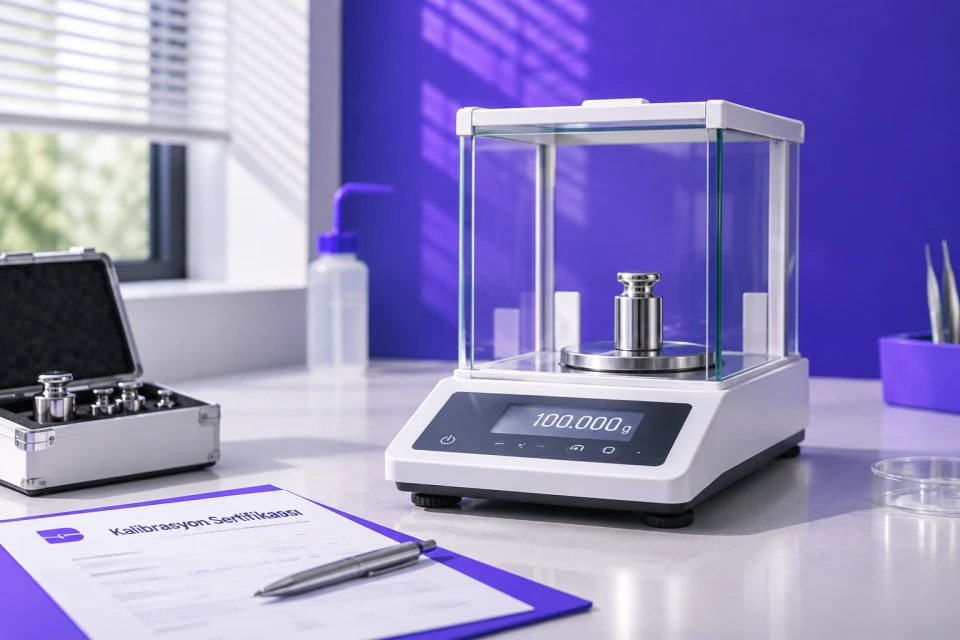
Before first use, once the device has reached its operating conditions, perform the calibration procedure specified in the user manual. Adjust the balance if needed to correct any deviation. Some models may offer internal procedures, while others may use a different method. The manual specifies which option to use.
Calibration determines the deviation between the value displayed by the balance and the reference mass. Adjustment is the process used to correct this deviation. These terms should not be used to mean the same thing, and you should not assume that every device requires external weights.
6. Make final checks before weighing
- Empty pan: With the pan empty, check whether the display shows zero and is stable.
- Level: If the model has a level indicator, check that the bubble is centered.
- Parts: Check that the pan and any other parts are seated correctly.
- Check procedure: Follow your laboratory’s procedure for routine checks or repeatability tests.
Intended use and compliance
The fact that a balance has been set up or calibrated does not mean that it complies with regulations for every intended use. For devices used in commercial transactions in particular, check the device’s intended use and any compliance markings on it separately.
If you are choosing a device for laboratory or jewelry applications, you can browse the options in the precision laboratory balances and precision jewelry balances categories.
Frequently Asked Questions
Can I weigh something as soon as I turn on a precision balance for the first time?
First, wait for the warm-up time specified in the manual for your model. The time is not the same for every precision balance. Before first use, also check the manual for calibration instructions and whether adjustment is needed if a deviation is detected.
Is it necessary to use an external calibration weight after setup?
The same method does not apply to every model. If the user manual specifies an internal or external procedure, check it to find the method suitable for your device.
What checks should I make after moving the balance?
Level the balance again in its new location and follow the user manual’s instructions for calibration and, if needed, adjustment after moving it. Then check that the display reads zero and is stable with the pan empty.
Conclusion
Setting up a precision balance starts with choosing the right location and is completed by following the instructions specific to the device’s model. Install the parts according to the manual, check the level and power source, wait for the specified warm-up time, and perform the calibration procedure specified by the manufacturer, along with any necessary adjustment.
Terazibul provides scale sales, calibration/adjustment, and technical service in Üsküdar, Istanbul. For technical service, visit the scale technical service page. You can also browse the relevant product categories to find devices suited to your application.


 Buy-Back Eligible Product
 Warranted Refurbished Scales
 Trade-In Eligible Product

Comments (0)