


How to Choose a Jewelry Scale: M Approval, Capacity and Precision Guide
When choosing a jewelry scale, learn to read what the M mark means, along with capacity and precision values correctly. Find out what to check for commercial use, small sample weighing and periodic inspection.


When choosing a jewelry scale, first check that the scale carries the commercial use markings that fit your purpose, then check the capacity and precision information. The M mark matters for non-automatic scales used in transactions where the price is determined by weight, but M alone does not show that a scale is suitable for every transaction or how precise it is.
For the right choice, review the Max, Min, class and e values on the device label. Along with your heaviest weighing, take into account the tare of the weighing pan and the smallest piece you will weigh. The number of digits on the display alone does not mean reliable weighing or suitability for commercial use.
What does M approval mean?
Scales that are assessed for suitability for commercial use carry an additional metrology marking together with the CE mark. This marking consists of the letter M inside a rectangle, the last two digits of the year in which the marking was affixed, and the identification number of the notified body that follows the markings.
The M here is not a precision indicator meaning "milligram." In addition, the M mark alone does not satisfy the inspection and stamping requirements during the device's service life. The suitability of a scale should be assessed together with the transaction it will be used for and the applicable rules.
When buying a scale, do not look only at the product family name or the seller's description. Approved and non-approved variants for commercial use can exist within the same family. Check the label and technical documentation of the individual model you choose.
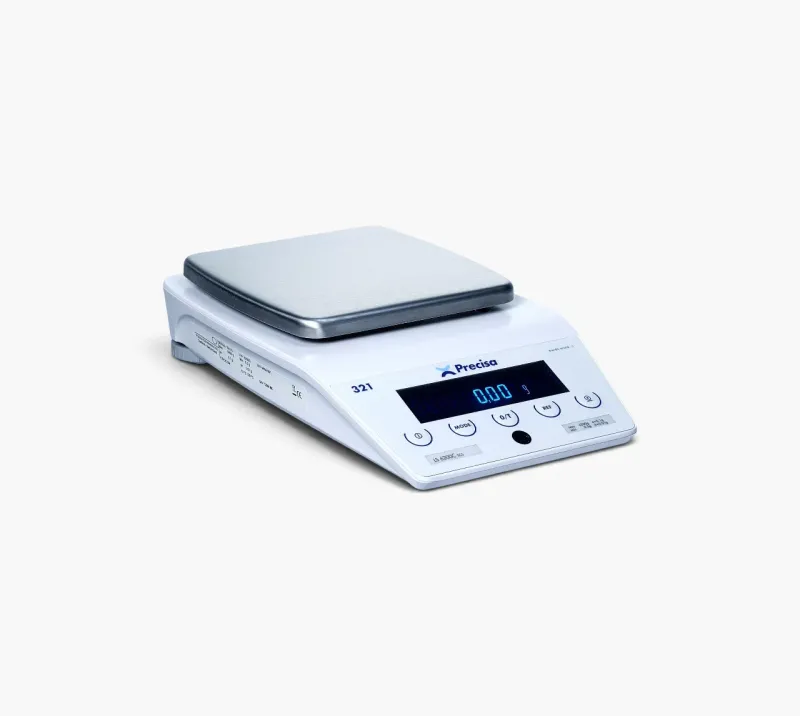
Capacity: Read Max and Min values together
Max shows the weighing capacity of the scale, and Min shows the stated minimum capacity. Along with your heaviest weighing, take into account the weight of the container or weighing pan you will use. When weighing with a container, the total load must stay within the capacity limits of the device.
Choosing a capacity higher than necessary is not a better choice in every case. Evaluate your weighing range, your heaviest item or sample and the container tare together, and confirm that the model's Max and Min values suit your use.
Precision: d, e and the digits on the display
d is the difference between consecutive values shown on the scale's display. e refers to the verification scale interval. On some class I and II scales, d can be smaller than e. For this reason, seeing more digits on the display does not mean the same digit precision can be used in a commercial transaction.
In the OIML R 76 table, for class II the upper limit of the number of scale intervals Max/e is 100,000. The minimum capacity is Min 20e if e is 0.001–0.05 g, and Min 50e if e is 0.1 g or more. These are general class criteria. Confirm the class and e value of the model from the product label or technical documentation.
Readability, repeatability and linearity deviation are also separate technical specifications. If you will be weighing small stones or pieces in jewelry work, check the minimum sample weight and repeatability as well as readability. The smallest increment the display shows is not the same as the smallest sample that can be weighed reliably.
In particular, do not assume that every scale showing 0.01 g can be used in jewelry work or in commercial transactions. For a more detailed look at this distinction, you can read our guide on scales that show 0.01 g.
When comparing features
- M mark: It is part of the additional metrology marking. Review it together with the CE mark and the model's other conformity information.
- Max and Min: Shows the capacity range. Take into account the heaviest load and the container tare.
- d and e: Indicate the display interval and the verification scale interval. Evaluate the values on the label together with the model's class.
- Minimum sample and repeatability: Help assess performance in small weighings. Check suitability for the smallest piece you will weigh in the technical documentation.
Inspection and calibration are not the same thing
A scale manufactured or approved for commercial use is not exempt from the periodic inspections required during its service life. In the Ministry of Industry and Technology's 2025 announcement, class I and II non-automatic weighing instruments are listed among the weighing instruments with a two-year periodic inspection period. For applications and current requirements, rely on the relevant official announcements and inspection application channels.
Calibration and legal inspection or verification are not the same process. In OIML terminology, verification relates to assessing whether legal requirements are met. For technical service and calibration support suited to your business, you can get information on our scale technical service page.
Short checklist before you buy
- Decide whether you will use the scale in a transaction where the sale price is determined by weight, or only for internal checks in your business.
- Check the CE and additional metrology markings, the class and the e value of the individual model you choose.
- Compare the Max and Min values, taking into account the heaviest weighing and the container tare you will use.
- Review the minimum sample weight and repeatability information for the smallest piece you will weigh.
- Separately evaluate the conditions of your place of use and the inspection requirements that apply to commercial use.
Frequently Asked Questions
Does the M mark show that the scale has milligram precision?
No. M is part of the additional metrology marking. To assess precision, look at d, e, the class and the performance information in the technical documentation.
Is a scale that shows more digits on the display more precise?
This information alone is not enough. d and e can be different values. For small samples, the minimum sample weight and repeatability also matter.
Does calibration replace legal inspection?
No. Calibration and legal inspection or verification are different processes. Depending on the intended use of the scale, evaluate the need for each of them separately.
Conclusion
When choosing a jewelry scale, do not decide only by gram capacity or the digits on the display. Check the M mark, the model's Max and Min values, the class and e information, and its suitability for small samples together. You can browse models in Terazibul's jewelry scales category, and you can create a service request for your selection or service needs.

 Buy-Back Eligible Product
 Warranted Refurbished Scales
 Trade-In Eligible Product

Comments (0)