


How to Spot Fake Gold: Gold Analysis by Density
How do you spot fake gold? Density analysis, acid testing and XRF compared. A practical checklist for jewelers and reliable preliminary evaluation methods.

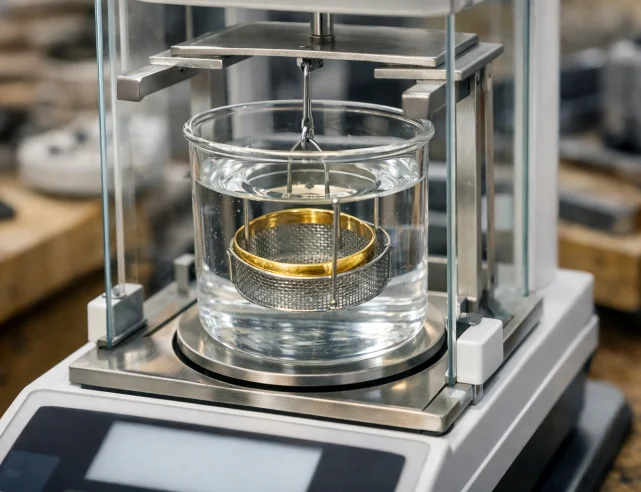
Fake or low-karat gold is both a financial and a reputational risk for jewelers and businesses that buy and sell. Acid testing, XRF and visual inspection are common methods. For everyday counter use, a fast, chemical-free and repeatable preliminary evaluation is most often done with gold analysis by density. In this article we clarify how to spot fake gold, how density measurement works and what you need to watch out for.
Why is fake gold so common?
As gold prices rise, plated, filled, tungsten-core or low-karat pieces show up more often on the market. Especially in scrap purchases, counter-top evaluation and fast buying and selling, a wrong decision can cause serious loss. That is why a reliable gold analysis process at the jeweler protects both customer trust and business profitability.
Methods used to tell fake gold apart
1. Visual and magnetic check
Craftsmanship, hallmark, color and magnetic attraction give the first clues. For high-quality fakes, these checks may fall short. Deciding on them alone is risky.
2. Acid and touchstone test
This is a classic method. It requires experience and carries the risk of scratching the sample or chemical exposure. It is fast but operator dependent and may not be ideal for every piece.
3. XRF (X-ray fluorescence) analysis
It gives strong data about the surface composition. The investment cost is high. On plated pieces, the surface result may not fully reflect the inner structure.
4. Gold analysis by density (Archimedes)
The density is calculated by measuring the weight of the piece in air and in water. The value obtained is compared with the known karat densities. It offers a fast preliminary evaluation at the counter without chemicals. It is one of the most practical methods in the daily workflow of jewelers.
How is gold purity measured by density?
The density of pure gold (24 karat) is approximately 19.3 g/cm³. In alloys such as 22, 18 and 14 karat, the density drops. The logic of the measurement is as follows:
- Weigh the piece in air
- Weigh the piece submerged in water (or place it in the density kit of the instrument)
- Calculate the volume and the density
- Compare the result with the known gold karat density table
A gold analysis balance with 0.001 g readability gives a more reliable density calculation even on small pieces. For example, the CTL600-K gold analysis balance offers density analysis based on the Archimedes principle with 600 g capacity and 0.001 g precision. It is designed for a quick purity pre-check at the jeweler's counter.
Limits of the density test (an honest warning)
Density analysis is a strong preliminary screen. It is not final proof on its own in every scenario:
- Tungsten core: The density of tungsten is close to that of gold. On filled pieces, the density test can be misleading.
- Hollow or composite structures: Air voids or different metals throw the result off.
- Dirty surface or air bubbles: They increase the margin of error during weighing in water.
- Very small samples: Readability and weighing technique become critical.
For this reason, in professional processes density analysis should be used together with hallmark inspection, acid or XRF when needed, and experienced judgment.
A practical checklist for jewelers
- Check the hallmark, craftsmanship and magnetism
- Weigh a clean, dry sample in air
- Measure in the density kit with the correct water level and no bubbles
- Compare the result with the karat table. If there is a deviation, confirm with a second method
- Do not mark suspicious pieces as "certain purity." Apply an additional test
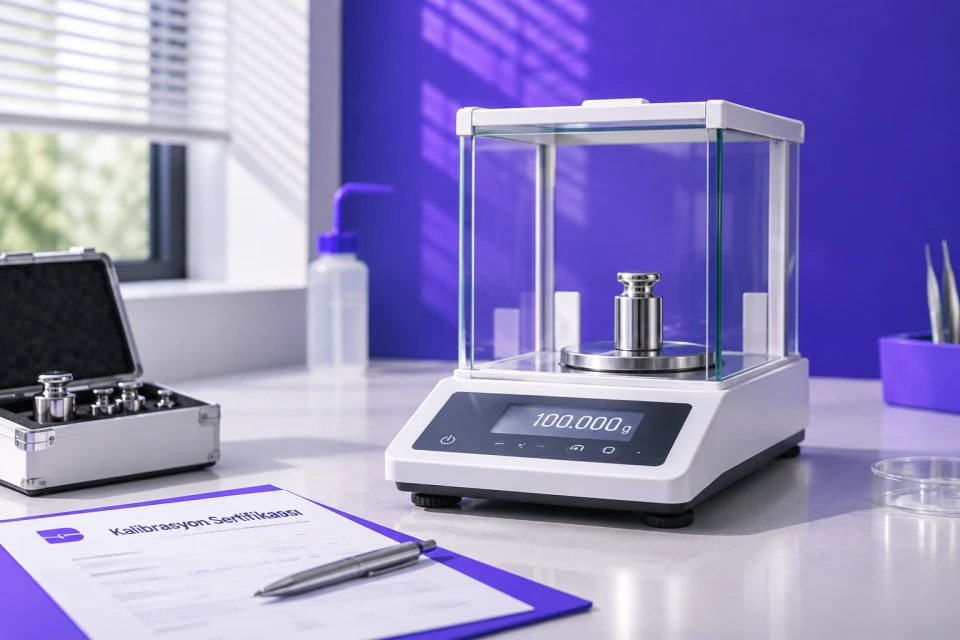
- Calibrate the instrument regularly and verify it with a reference weight
Features to look for in a good gold analysis balance
- At least 0.001 g readability
- Sufficient capacity (from a ring to a bracelet or small scrap)
- A density measurement kit and Archimedes compatibility
- Fast settling and a stable reading
- Easy calibration and accessible service
The CTL600-K meets these needs with its 600 g / 0.001 g configuration and its density-analysis-focused use case. For model details and technical specifications, you can view the product page. For similar models, you can also check the gold analysis balances category.
Frequently Asked Questions
Can fake gold be identified for certain with a density test?
In most low-karat or mixed-metal pieces, the density deviation is clearly visible. In special forgeries such as tungsten-filled pieces, density alone may not be enough. An additional method is needed.
Acid or a density balance for gold analysis?
Acid testing is traditional and fast. A density balance offers a chemical-free, repeatable preliminary evaluation that can be recorded. Many jewelers use the two as complements.
Can 14 karat and 18 karat be told apart by density?
In most cases yes, there is a clear density difference between karats. However, the alloy composition, solder and stones can affect the result. For an accurate result, 0.001 g precision, a clean sample and error-free underwater weighing are important.
What happens to plated gold in a density test?
On thin plating, the density of the inner metal can dominate the result. The value deviates from the expected gold karat. This gives an additional verification signal for the suspicious piece.
What is the CTL600-K suitable for?
It is suitable for preliminary gold purity evaluation at jewelry counters, assay offices and precious metal laboratories. With 600 g capacity and 0.001 g precision, it meets the daily need for density analysis.
Conclusion
Telling fake gold apart cannot be reduced to a single magic test. The right process is a combination of visual inspection, density analysis and, when needed, chemical or XRF verification. Density-based gold analysis helps you screen out risky purchases early while increasing counter speed.
If you want to choose the right instrument for your business, take a look at the CTL600-K Gold Analysis Balance or get model and calibration support from the Terazibul team.

 Buy-Back Eligible Product
 Warranted Refurbished Scales
 Trade-In Eligible Product

Comments (0)